
Full text of the trance, with the time each section begins. Stage directions and pauses are left out.
Before we begin
Before we begin, a few plain words. This is a guided relaxation that uses hypnotic language. Listen when it’s safe to close your eyes, never while driving or doing anything that needs your attention. It doesn’t replace care from a doctor or a therapist. If you live with pain during intimacy, with memories of being forced, or with fear in your own home, please speak to someone qualified first, and come back to this later, when it’s right for you. Nothing here works against your faith, your will, or your choices. You stay in charge the whole time. If at any moment you need to come back, simply open your eyes, press your feet into the floor, and say your own name. You’ll be fully here. And if you’d like to ask someone you trust in your faith before you listen, that’s a good choice too. Taking care of yourself is part of haya. Choose a time when no one needs you. A room with a door you can close. And when you’re ready… we’ll begin.
Two kinds of thread
There’s a saying of the Prophet, peace be upon him, that many of us heard as children: haya brings nothing but good. Nothing but good. Hold that sentence for a moment, because it’s very precise. If haya brings only good… then whatever brings you harm, whatever makes you small and cold and ashamed of a body God made… cannot be haya. It may be wearing haya’s clothes. It may have borrowed her voice. But it isn’t her. Many women carry both, sewn so closely together that they feel like one thing. The modesty that protects you. And the shame that pinches. Tonight you don’t need to give anything up. You keep your haya. All of it. You only learn to tell the two threads apart… and let one of them go.
Settling
So let yourself settle now. Sitting or lying down, let the surface beneath you take your weight. Where your back meets it… where your hands rest… where your feet are. Some women like to loosen something first. A clip in the hair. A belt. A scarf around the throat. If you’d like to, do that now… and if you’d rather leave everything as it is, that’s just as right. And when your eyes feel like closing, let them close. Or let them rest on one point in the room until they grow heavy on their own. Either way works. There’s nothing you need to do correctly here. Whatever you notice is part of it.
Wudu: the hands
You’ve made wudu more times than you could ever count. Before dawn, half asleep. At midday, in a hurry. In the evening, slowly. Your body knows the order better than your mind does. So you don’t need to think about it now. Only imagine it… and let your body remember. Imagine water. Cool, clean water. Maybe from a tap at home, maybe from a fountain in an old courtyard. It runs over your hands. Once… and your fingers soften. Twice… and whatever your hands held today, the phone, the cups, the bags, the worries, rinses away. Three times… and your hands grow heavy and warm and still. You don’t have to wash them correctly. This isn’t the prayer. It’s only the memory of water… and the memory knows how to let go.
Wudu: the face
The water rises to the mouth now. Rinsing away the words of the day. The ones you said. The ones you swallowed. Your jaw can loosen. Your tongue can rest. And now the face. Cool water in both palms… lifted… and spread from the forehead down to the chin. The forehead smooths. The small muscles around the eyes let go. The eyelids grow heavy… heavier with each wash… as if the water were carrying off everything the eyes took in today. Once. Twice. Three times. And the face that remains is simply your face. Clean. Quiet. Nothing to hide and nothing to show.
Wudu: arms, head, feet
The water runs along the right arm… up to the elbow… and the arm sinks. Then the left… and it sinks too. Wet hands pass over the head, from the forehead to the back of the neck… and the thoughts slow down under them. Over the ears… and what you heard today grows quiet. And last, the feet. Water between the toes… over the ankles… washing off the places you’ve walked, the floors you’ve stood on for other people. Your feet grow heavy and warm. You were taught, long ago, that with the last drop of the water… what clings to you falls away. Let something fall away now. You don’t even need to know what it is. And notice: wudu washes what clings. It never washes you away. You are still here… only lighter.
The grandmother’s courtyard
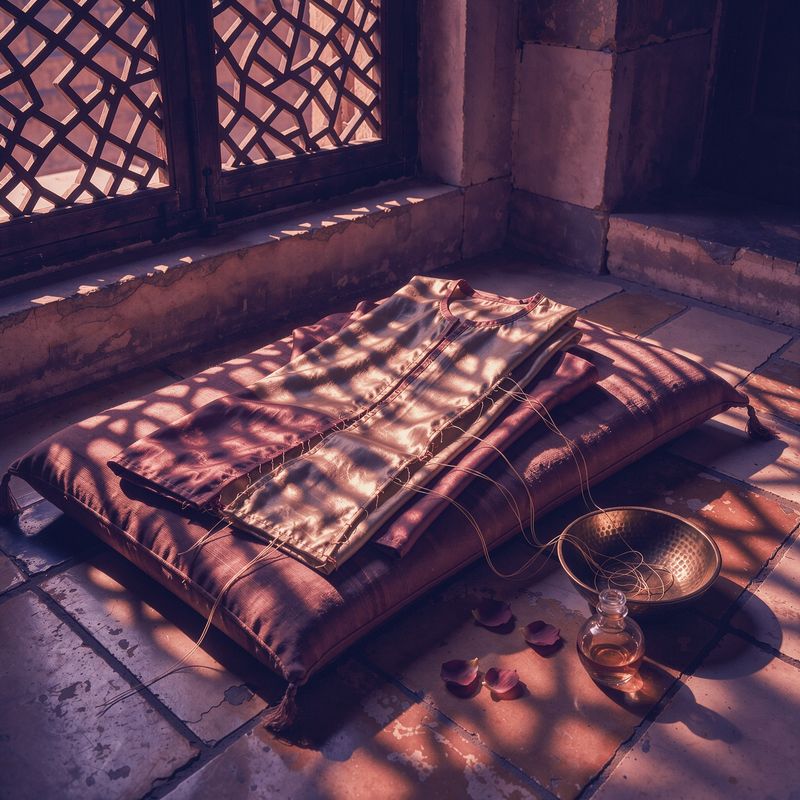
Now, freshly washed, imagine an old wooden gate in a wall of warm stone. It opens onto a courtyard. A fountain, maybe. A lemon tree. The smell of rose water and warm tiles. On the far side, ten stone steps lead down into the cool of the house. I’ll count them with you. With each step, let yourself sink a little further into comfort. Ten… Nine… cool stone under clean feet. Eight… Seven… the scent of roses following you down. Six… Five… halfway, and the light grows soft. Four… Three… nothing to do, nowhere to be. Two… One. A quiet room. A rug. A low cushion. A window with a carved wooden lattice, and sunlight falling through it in small patterns on the floor. And no one will knock.
The grandmother
And there’s someone in this room. An old woman, sitting near the window with her sewing in her lap. Maybe she’s your own grandmother. Maybe she’s the grandmother you would have wished for. Maybe you can’t see her face at all, only her hands, and you know her anyway. She looks up as if she’s been expecting you. She doesn’t ask what took you so long. She pats the cushion beside her. Sit, she says. You’ve done enough for today. And as you sit down beside her, you may feel your breathing change… slower… deeper… the way it does near someone who has never once needed you to be anything other than what you are.
The garment
She looks at what you’re wearing. Not the clothes you put on this morning. Something older. A garment that has been with you for a very long time. It might be a long dress. A robe. A shawl around your shoulders. Many hands sewed this, she says. Your mother’s. Mine, too, perhaps. Aunties. Teachers. Neighbours who looked a little too long. Sayings you heard before you could read. Most of those hands meant well. They sewed with the thread they had been given. Some stitches hold you the way a warm hand holds you. And some stitches… pinch. Without changing anything yet, find where the garment sits tight. Around the throat, maybe. Across the chest. Low, around the belly and the hips. Or somewhere else, or nowhere you can name. Whatever you find is enough.
Telling the threads apart
She takes the hem between her fingers. Two kinds of thread, she says. This one is soft. Warm. It moves when you move. It breathes when you breathe. That is haya. It knows what is private and what is public. It lets you choose who sees you, and when, and how much. And this one is stiff. Cold. It tugs when you take a deep breath. It tightens when you want something. It pulls hardest when you feel pleasure. That is shame. You don’t need a scholar to tell them apart, she says. Only one question. Does this stitch bring you good? If it does, it stays. If it doesn’t… it was never haya.
Layla’s walls
Before we start, she says, threading her needle, do you know the story of Layla and Majnun? A young man named Qays loved a girl named Layla so much that people stopped using his name. They called him Majnun. The one who lost his mind. They say he walked past the walls of her house and kissed them. This wall… and that wall. And when people laughed at him, he said: it is not love of the houses that has taken my heart. It is love of the one who lives inside them. She smiles and says nothing more. I’ll tell you the rest, she says, when your hands are free. And the story waits… somewhere at the back of your mind… while she leans towards the collar of your garment.
The first seam: the throat
The stitches around the throat are made of words, she says. Don’t ask about that. Don’t talk about that. A good girl doesn’t say such things. Maybe you recognise some of them. Maybe yours are different. Take one of those cold threads between your fingers. You don’t need to pull. Just hold it. And as you breathe out… slowly… feel it loosen. One stitch. Then the next. With every breath out, one stitch gives. The soft threads stay exactly where they are. Your voice is still yours. Your privacy is still yours. Only now there’s room in your throat… to swallow… to speak… to make a sound, if you want to.
The second seam: the heart
The seam across the heart is the tightest, she says. Its stitches say: a good woman doesn’t want. Wanting is your nafs. Hide it. Listen, she says. The nafs is not one thing. It has rooms. There’s the nafs that commands, that grabs at whatever it sees. There’s the nafs that blames. The Qur’an calls it the self-reproaching soul. It watches you. It scolds you. It sewed many of these stitches, and it meant to keep you safe. Thank it. It worked hard. And there’s a third room. The nafs at rest. The soul at peace. Wanting the one you married, in the place where it belongs… that isn’t the grabbing nafs. That is the nafs at rest… at home in its own house. Breathe out… and let the blaming voice lay down its needle. Another breath… another stitch gives.
The third seam: belly and hips
And now, lower. The seam around the belly… around the hips. Some of the stiffest threads are here. Threads that say: this part of you is a problem. Keep it quiet. Don’t feel it. But this is the same body that bows in prayer, she says. The same body God made, and made well. Find one of those threads now. And breathe out. One stitch. And another. Let the sunlight from the lattice fall across your lap. Feel its warmth… through the fabric… into the skin… into the belly, which can soften now… into the hips, which can grow heavy and easy. Warmth spreading the way honey spreads across warm bread… slowly… without hurry. It’s allowed to be there.
Halfway, deeper
And as those seams loosen, you may find you’ve drifted even further into this quiet. I’ll count from five down to one, and with each number, let the garment settle around you in its new shape. Five… Four… breathing more easily now. Three… the scent of roses, close again. Two… One. Deeper… and softer… and more completely here. Part of you can listen to my voice… while another part simply rests beside her… and both of them are exactly right.
The bowl
She holds out a bowl. Brass, or clay, or wood. One by one, place the loose cold threads in it. You don’t have to know whose they were, she says. And if you do know… you don’t have to blame anyone. I received some of these from my mother. She received them from hers. Each of us did what we could with the thread we were given. Keep the warmth we gave you. Give back what was never yours to carry. Maybe you say it silently: this is not mine. I’m putting it down. And then put it down. The bowl fills. Your lap grows lighter. No need to burn the threads, or to be angry at them. They simply stop being sewn into you.
Duty and sadaqah
She sets the bowl aside and looks at you for a long moment. They taught you it’s a duty, didn’t they, she says. Something you owe. The Prophet, peace be upon him, said that in the intimacy of a husband and wife there is sadaqah. Charity. And think about what sadaqah is. It’s never a debt. It’s a gift. It’s given… and it’s received. When you’re cared for, when you’re touched with patience, when you’re given time… that’s sadaqah too. And you are allowed to receive it. The scholars wrote that a husband shouldn’t hurry away until his wife has had her fulfilment as well. Your pleasure was never an extra, she says. It’s part of the gift. Let that settle… somewhere below the ribs.
The garment that fits
She smooths the fabric over your knees. It’s the same garment. The same colour. Your haya is all still there, every soft thread of it. But now it moves when you move. Lift a hand, in your imagination… and the sleeve follows like water. Take a full breath… and the fabric rises with you. Do you remember the verse, she asks. They are a garment for you, and you are a garment for them. A garment is close. It touches the skin. It keeps out the cold. It covers what is private… and it’s warm from the body that wears it. Not a garment that pinches. A garment that fits.
Majnun’s eyes
Now your hands are free, she says. So here is the rest of the story. A ruler once heard of Layla and wanted to see the woman who had driven a man out of his mind. So she was brought to him. He looked at her and said: this is Layla? She’s no more beautiful than any other woman. And the answer came: to see Layla, you need Majnun’s eyes. Beauty is seen by eyes that love, she says. And you can borrow those eyes. Look at yourself now, the way Majnun looked at Layla’s walls. Your hands. Your skin. The shape of you under the garment. Not to judge. Only to see what a loving eye sees. And maybe you notice that the house you’ve lived in all your life… is worth kissing too.
Tasting
The Sufis spoke of a kind of knowing that comes through the senses. Dhawq. Tasting. You can’t learn the sweetness of a date from a book. So taste something now. The skin of your arms… your neck… the inside of your wrists. Maybe it’s tingling. Maybe it’s warm. Maybe it feels more awake than before. Whatever you feel is fine. The softness of the fabric where it touches you. The weight of your own hand resting on your body. The small pleasure of a breath that goes all the way down. Pleasure doesn’t have to be loud to be real. It can be this quiet. And you can let it be there… without explaining it… without apologising for it. Haya keeps it private. And without shame… it’s simply yours.
The closed door
Now imagine an evening, some time from now. Your own home. The bedroom door… closed. Haya has done her work. She has kept the world outside. And inside that door… shame has no job left to do. She can rest. Your husband is there. The lamp falls on his face. You know the scent of him. And you find something new in yourself. Not a performance. Not a duty. Something warmer. Maybe you reach for his hand before he reaches for yours. Maybe you lean in. Maybe you simply stay… and let yourself feel what you feel… slowly… without hurrying away from it. Your body knows what to do with that warmth. It always did. It just needed the stitches to loosen.
Your voice
And in that room, your voice is free too. Haya doesn’t silence you. It lets you choose your words… and say them to the one person who should hear them. Perhaps you hear yourself say something simple. Stay. Slower. Like that. I’d like… And the other word is free as well. Not tonight. That word is just as much a part of haya as yes. A gift is only a gift when it’s freely given. Yes without shame. No without guilt. Both of them… yours.
The collar
Before you leave, she touches the collar of your garment with one finger. Here, she says. Whenever you need it. In a moment, if you like, let the fingertips of one hand rest lightly at the base of your throat… just where a collar would sit. And take one slow breath in… and let it out, long and easy. Do that now. Good. Every time you do this in your waking life… fingertips at the collar, one slow breath out… a seam can loosen. The stiff threads give… and the soft threads stay. The more often you use it, the quicker it works. It belongs only to you. No one else can set it off. It works only when you choose it.
Tomorrow and after
Let’s step forward in time. To tomorrow. An ordinary moment. Standing at the sink. Choosing what to wear. Fixing your scarf in the mirror. Something is slightly different. A little more room in the chest. A little less bracing in the shoulders. Maybe you look at your reflection a moment longer than usual… with Majnun’s eyes. And a few weeks from now, an evening, the house gone quiet. Maybe you said what you wanted, and the world didn’t end. It got warmer. Maybe you said not tonight, and you didn’t carry it around afterwards like a stone. Maybe it’s something I couldn’t possibly predict… because it’s yours. And if an old stitch tugs, you know what to do. Fingertips at the collar. One breath out. And it gives.
The soul at rest
Let the heart of this settle into you now, in your own voice. Repeat it silently, or simply let it sink in. I keep my haya. I give back the shame. I’m allowed to want. I’m allowed to receive. I’m allowed to say no. And notice how you’re sitting now. Upright inside. Warm. Collected. There’s a verse for this feeling. O soul at rest… return to your Lord, well pleased, and well pleasing. Well pleased… and well pleasing. Let that be the feeling you carry out of this room.
Coming back to yourself
Now it’s time to start coming back. Leave the bowl of threads with her. She’ll keep it. She squeezes your hand once… and you stand up, and walk up the stone steps, one by one, into the courtyard, into the light. And as you come up, remember who you are. Say your name to yourself. Your full name. Remember your age. The city you live in. The room you’re in right now. What day it is. Feel the full weight of your body against the surface beneath you. Your back. Your hips. Your heels. Feel your feet. Press them gently down. You’re wearing the same garment you came in with… and it fits a little better than it did.
Back
I’ll count from one up to five. With each number, you’ll become more awake, more alert, more here. And at five, you’ll open your eyes, feeling clear, rested, and completely yourself. One… breath coming in deeper. Two… the room around you, its sounds, its temperature. Three… moving your fingers, your toes, stretching a little if you like. Four… a fresh breath, eyes ready to open. Five. Eyes open. Wide awake. Take a moment before you get up. Have some water if you like. And as you go about your day, notice how easily you move inside your own clothes… calm, and upright, and at rest.